Examples of
Phony Photos
On this page are two photos that scam artists operating around the refugee camps in Thailand tried to pass off as photos of live US POWs. I saw each of these several times during my tenure in DIA -- 1986 - 1990. The story behind each photo is beneath the photo.
Photo #1: Mr. Kamm, US POW (Well, not exactly)
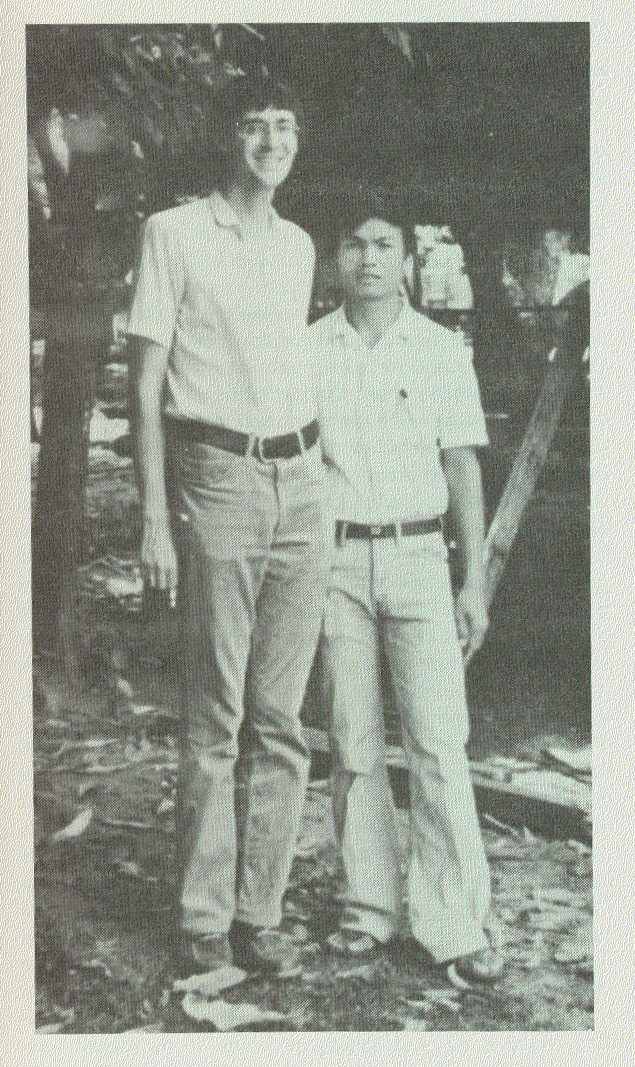
"Mr. Kamm"
and Friend
The story
This photo was a regular among the refugees. Usually this photo was brought to US interviewers by a Vietnamese refugee or a Lao "resistance fighter." It was all very hush-hush -- the person or people with the photo had a secret to tell. No one ever brought an original photo --always came in with photocopies of photocopies of photocopies.
The story had a few variations but the basic story was this.
The tall man on the left is an American prisoner being held (somewhere). His left arm was cut off (when he bailed out of his airplane; when he was attacked by PAVN soldiers). The guy on the right is his guard. I know the guard. If the US government will pay to me $XX,XXX, I can free this American POW. Why do I need the money? To bribe guards, village chief, etc. Some inventive sources claimed that "Mr. Kamm" was shot down, lost his arm in the shoot down, and was protected and nursed to health by "villagers." In gratitude, he married the village chief's daughter. Now, he and the whole village want to go to the US -- need money for travel expenses. Honest, folks, I swear that's what one guy told us.
When this photo was brought to US interviewers, frequently there was an inscription on the back, something like "USN 12345." That person presenting the photo claimed that this was "Mr. Kamm's" service number.
The facts
"Mr. Kamm" is, indeed, Mr. Kamm. Greg Kamm, US Peace Corps worker in Thailand. Not a US POW; never served a day in uniform. Not missing his left arm. The short guy is a friend of Kamm's. Kamm told US interviewers that this photo was among many things stolen during a break-in at his friend's home in NE Thailand.
One Sunday Afternoon
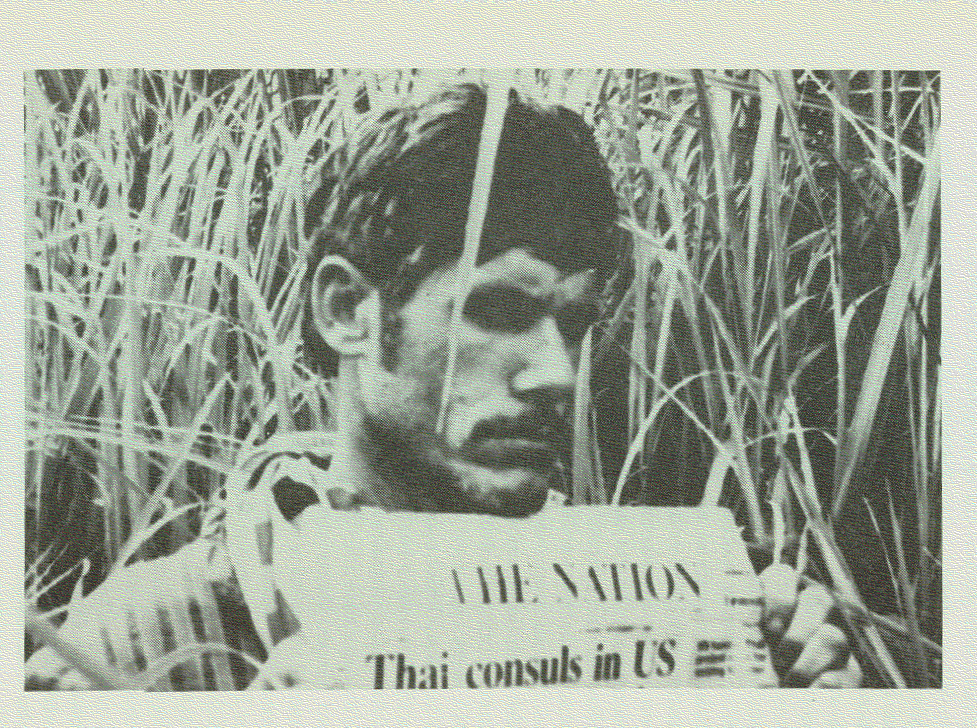
The Story
One Sunday afternoon, I was half-asleep in front of a Redskins game on TV when the phone rang. It was an Air Force officer with whom I had been in Chinese language school. He was now out of the USAF and was working with an international arms dealer. He had just talked with an Israeli friend of his in London. The Israeli had just received a photograph of a US POW being held right now in Laos.
I called the guy in London who went through a long story about how his friend in Thailand had received this photo. It was only a couple of days old -- in fact, the date on the newspaper was 2 or 3 days earlier. What to do? I told him to take the photo and the accompanying letter from his friend to the US Embassy in London. I called the Embassy and alerted them. The Embassy overnighted the photo to us in DIA and made copies that were overnighted to the embassy in Thailand.
According to the letter from the Israeli's friend, the guy in the photo was a US POW who had been rescued and moved to a jungle hideout close to the Thai - Lao border. If the US would put up $XXX,XXX (I do not recall the amount), then the guy would be freed. There was a long, elaborate system of signals, money put into dead drops -- all very spooky.
The Facts
Almost immediately after the photo arrived in the US Embassy in Bangkok, a consular officer in the embassy recognized the guy as an American living in NE Thailand -- Mr. Charles Strait. Strait was a former USAF member who served in Thailand in the 1970s, married a Thai lady, and decided to live in Thailand.
US interviewers went to Strait's home and here is the story he told. He was approached by two Thai who offered him money if he would pose as a US POW. He agreed and was taken to a house and told to wait in the back room. He heard a car drive up and some guys speaking with an Aussie accent enter the house. There was then much discussion -- in English -- between the Aussies and the Thai. The Thai told the Aussies that they could deliver to them (the Aussies) a real, live US POW and they needed some money up front. No one could agree on a price so the Aussies left and Strait never got paid nor did he get to perform as a US POW.
In Conclusion
Occasionally, an enterprising source would come to US interviewers with one of these photos -- or a similar photo -- and would claim that this photo was a picture of _____ -- and he would name a real MIA. The problem is that names of missing Americans were readily available. Families visited the refugee camps and distributed leaflets with their missing man's name, photo, etc.; "activists" such as Billy Hendon spread flyers, videotapes, and word of mouth through the camps, including the names of missing men. In every case where a photo was claimed to be that of a missing man, US interviewers either had their own copy of the photo and were able to confront the source with the phony photo, or, they were able to get the source to admit that the tale was phony. Still, when the name of an MIA was attached to a photo, we were bound by policy to inform the family. You can imagine the effect of that news on families of missing men.
Shame is that we wasted zillions of hours tracking down this sort of stuff. The first time we received a photo, we went all out to identify it. From then on, we wasted little time on them as they would re-appear with a slightly different story.