"Bo" Gritz:
The Mission He Was Never On
(but that he lied about)
March 9, 2026: Bo Gritz died today at age 87.
Summary. In January 1966, seventeen Special Forces soldiers divided into three teams went into the An Lo Valley area of South Vietnam. One team encountered heavy contact with enemy forces two days after they were inserted. Of the seventeen, five were killed, two are missing in action, and three were wounded. One individual who was not on the mission was retired LTC James "Bo" Gritz. He was not even assigned to the unit and, at the time of this mission, Gritz was hundreds of miles away in another part of Vietnam. Yet, on 29 May 1981, in a speech to a Vietnam Veterans group at the Statler Hotel in Buffalo, NY, Bo told a heroic story about the mission in which he claimed to have been part of the operation. In 1983, Soldier of Fortune magazine published a special POW-MIA issue that included a number of stories revealing the phony claims that Gritz made regarding his own military background and his "POW rescue operations." If you can find a copy of that issue, read it. I have my own copy and I have typed the entire article about the mission that Bo was never on.
You may also want to read the other Gritz stories on the MIA Facts Site:
Medals Rained From the Heavens
and A Legend in His Own Mind
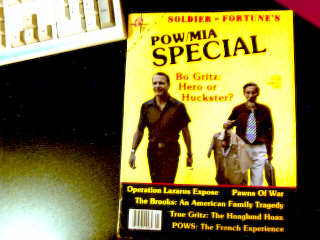
The following article is a direct quote taken entirely from the Spring 1983 Special POW-MIA issue of Soldier of Fortune magazine. The cover of the magazine is pictured here. Sorry about the quality. I took this shot with my handheld webcam and I got the corner of the keyboard in the picture.
This is a similar photograph of the first page of the article that deals with the mission that Gritz was never on. I have typed the entire article, starting below this photo.
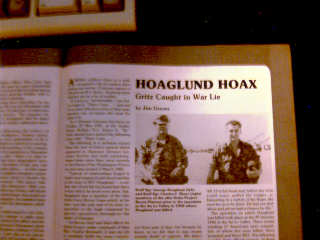
Begin QUOTE from Soldier of Fortune magazine, Spring 1983, Special POW-MIA issue, Pages 51 - 53.
HOAGLUND HOAX: Gritz Caught in War Lie
-by Jim Graves
Among soldiers there is a well-recognized code of conduct when telling war stories. Everyone expects a 10 percent B.S. factor. Anything more will get you in a lot of trouble.
If a story is "questionable," one better begin it" "There I was. . . " and end it on some ridiculous note so that compatriots can recognize the story for what it is.
At a Vietnam Veterans luncheon on Friday, 29 May 1981, at the Statler Hotel, Buffalo, N. Y. James G. "Bo" Gritz should have started the following story with "There I was . . . "
The following is a verbatim extract from the text of Gritz's speech which appeared in National Vietnam Veterans Review and with variations, many times since then, most recently to Art Harris of the Washington Post in an interview printed 3 March 1983.
(Note: This is a verbatim quote of
Gritz's speech.)
"Typical of relationships forged in battle and tempered with blood and fire is the
story of SFC Hoaglund -- a soldier who loved life but found that there is that which he
loved even more. Sgt. Hoaglund was a member of the elite Delta Force Recon
Team which, at the time, was the only unit of its kind, responsible to the high command
for special operations throughout the whole of Vietnam.
"As Recon Chief and Intel officer for Delta Project under command of then Maj. Charlie Beckwith, it was my job to establish SOPs for every conceivable contingency. Because these standard procedures could mean life or death, I openly discussed them with the other 26 men in Recon. A question came up about what to do in the likely event that one of us was hit and unable to continue while behind the lines. With one exception, the group said the wounded member should be left behind in order that the mission and men might survive. I was that dissenter, knowing deeply that we would never leave a buddy.
"Our SOP was soon put to the test during an operation in the Ia Drang Valley to locate heavy troop concentrations. As happened all too often, we landed right in the middle of the lion's den. While fleeing to the pickup zone, Sgt. Hoaglund was hit by one of many machine-gun bursts that cracked by our ears. He was tail gunner in our five-man team, covering our rear.
"It was as if we were all hit when Hoaglund went down, his legs shattered. We all crashed back through heavy jungle to encircle our comrade. Hoaglund was frantic, not from pain or fear, but because he knew, as we did, that to stay meant certain death or capture. We didn't even have time to tourniquet his severed artery.
"The enemy was upon us. Even as we stacked magazines and straightened pins on our remaining hand grenades, bullets began cutting bark and vines all around us. Still we could hear Hoaglund screaming, 'Get the hell out of here, now!'
"It was simple; the battlefield is the most honest place on earth. We didn't need to speak, the communication was clear. We all hated the thought of death, but there was that we couldn't bear: leaving Hoaglund to die alone in enemy hands while we ran for our lives. I recall someone muttering, 'Knock it off; we're all going down swinging together.'
"I've relived those few minutes a thousand times since
that December 1965, and it still makes my heart overflow with emotion. It is a
soldier's nightmare to die alone without a comrade's last embrace; yet Hoaglund's unspoken
devotion and love for his buddies was stronger than life itself. With a whispered
goodbye and a last look at his friends, Hoaglund put his AR-15 to his head and, before any
of us could react, pulled the trigger, eliminating in a twitch of his finger the need for
us to be there. He had not died alone yet we had a chance for life."
(NOTE: End of verbatim quote of Gritz's speech.)
The operation on which Hoaglund was killed took place at the (sic) 29 January 1966 in the An Lo Valley. Three teams totaling 17 Americans were committed, of whom five were killed, three wounded and two MIA. The following is a list, from official sources, of those men:
TEAM 1
Keating, Henry A. SFC RA
19496375
Whitis, Robert P. SFC RA
22973251
Dupuis, Nurman C. SSG RA
21193828 (WIA)
Chiariello, Agostino SSG RA
12698873
Bell, Brooke A. SSG RA
52439074
TEAM 2
Webber, Frank R., Jr. SFC RA
13350193 (WIA)
Cook, Marlin C. SFC RA
14265805 (KIA)
Dotson, Donald L. SSG RA
14951119 (KIA)
Hoaglund, George A. SSG RA
28041136 (KIA)
Hancock, Jesse L. SFC RA
19368478 (KIA)
Hiner, Charles F. SSG RA
17429475 (WIA)
TEAM 3
Huston, Marcus L. SFC RA
16444521
McKeithe, Billy A. SSG RA
18477197
Gray, Wiley W. SSG RA
14288420
Terry, Ronald T. SSG RA
12471604 (MIA)
Hodgson, Cecil A. SFC RA
18488059 (MIA)
Badolati, Frank N. SSG RA
12327022 (KIA)
In short, Gritz was somewhere else when Hoaglund was killed. The battlefield may be the most honest place on earth. Apparently, the Statler Hotel in Buffalo, N.Y., isn't.
Most of America became aware that something was amiss in the Hoaglund story on 29 march 1983 when The Washington Times broke the story. The facts behind the Gritz-Hoaglund affair were actually tracked down by Col. Chuck Allen, (U.S. Army Ret.) publisher of the Vietnam Veterans Review and a highly respected former commander of Project Delta, and Tom Smith, former Studies and Observation Group (SOG) recon man.
Smith called the only living survivor from the Hoaglund team -- Chuck Hiner -- and put him in touch with Allen. Hiner dug back through his scrapbooks and produced not only a photo of the 17 men who went on the mission, but an official Army statement listing the men who participated.
Hiner, who says he doesn't even know Gritz, even though Gritz says he was the commanding officer of the Recon Platoon for Delta, tells a considerably different story about Hoaglund's death than Gritz.
According to Hiner -- and the records -- the team was inserted into the An Lo Valley at last light on 27 January 1966. Two wet days later -- it was raining hard -- the six-man team was sitting down taking a break when it came under heavy fire from a large force of Viet Cong.
"In the initial burst of fire Cook, Weber, and Hoaglund were hit," said Hiner "and I don't know but I think Dotson and Hancock were hit then too. I don't know for sure because they were on flank security. When we got hit I went to the top of the hill to keep anybody from coming over the hill on top of us.
"Cook (the radio man) was flank security on the left side and he couldn't get to the radio -- he was paralyzed. He called me back down and I cut the radio off him.
"There was a pile of rocks in the middle of this clearing so I took the radio in there and lay down on it and started calling.
"I called everybody and their mother who would answer.
"We kept getting fire in on us and fire in on us.
"After we got the FAC (Forward Air Controller, a Capt. Kenneth L. Kerr) on the radio and started doing our shit I started looking around. I could hear Dotson. He was hit through the chest and I could hear that death rattle. This other kid (Hancock) -- first trip in, first time on the ground, the whole nine yards -- he was dead. They had stitched him from the ankle to the top of his head. Hoaglund was more-or-less still alive. Cook lasted a long time in there but he finally died, I guess maybe about 1:00 or 2:00 o'clock that afternoon."
Webber had four bullets, all in the arm, from the first burst of fire and shortly after it started Hiner was wounded when he was shot in the head by a VC firing an AK-47.
"The dude shot at me the same time I shot at him," said Hiner. "I hit him first, though, and it caused him to jerk up. It (the round) went about a quarter of an inch in my scalp. It went down into the bone and just left a perfect groove.
"I had called airstrikes in on top of our position to keep from getting overrun. It was either do that or get overrun so 'What the hell.'
"We were fighting -- I would dare say the closest -- within 10 feet of each other. It was that tight. That's why, when I popped smoke and told the FAC to take it 360 degrees from the center of that, he said 'I can't do it because it will come in on you.'
"I said well it's either you or them. And that's the way it went.
"He didn't like it but I didn't like it either."
During a lull near the end of the battle, which lasted four hours, Hiner crawled down the slope to strip the dead -- Hoaglund, Dotson and Hancock -- of their ammo since he and Webber were almost out.
Hiner said when he got back to Hoaglund, he found him on his back, beside a tree, with the rifle muzzle pointing toward his head. "He had one arm shot off, the other was hanging by a thread."
When asked if he thought it possible Hoaglund cold have killed himself, Hiner said it was ridiculous. "How's he going to do it with no arms?" asked Hiner. He went on to explain that Hoaglund's position was ordinary under those circumstances. "On a break George always sat down, with his legs crossed and leaned his rifle back against his shoulder," said Hiner. "I've seen him do it hundreds of times. He was just blown away."
"Besides, I knew George Hoaglund as well as anyone; he was not the type to kill himself."
During the final minutes of the battle, two reaction forces moved frantically through the thick bush toward Hiner's position. One was from the 1st Air Cav., the other, that was first on the ground, was a Reaction Force from Project Delta commanded by a Lt. Holland -- Holland was the real commander of the Project Delta Recon platoon, not Bo Gritz -- and led by Sgt Maj. Walt Shumate, who later became an SF legend in his role as the Sgt. Maj. for "charging"Charlie Beckwith in many SF-commands.
"You know when I knew I had made it?" asked Hiner, who recounted that he and Webber, down to just a few rounds between them were crouched down behind a log. "I looked up and saw Walt's bare ass coming over the top of that log. Walt told me later he was busting bush so hard and fast coming up that hill, he had busted out his pants."
Walt Shumate's comments were short and succinct. "If he (Gritz) says he was on that one, he's a lying mutha."
We know from what Hiner has said as well as the official record that Gritz was not on he ground and from what Shumate said that he wasn't on the reaction force, either.
Where was he?
"Charging" Charlie Beckwith, then the commanding officer of Project Delta, answered that one.
"At that particular time, Bo Gritz was not assigned to the Delta Project. He was not a member of the Delta Project. He had been a member of the Delta Project prior to that time but he had left before Christmas 1965 and gone back to Tay Ninh down in III Corps. So he was not a member of the organization at all. He had been for a short time prior to Operation Masher.
"I thought Bo was a good soldier when he was in Delta. For a short time he was the recon officer for Delta but Bo and I had some -- not conflicts -- but differences.
"Differences in as much as our job at that particular time, our mission, the majority of time was to move out into those areas that were dictated by MACV (Military Assistance Command Vietnam) to do a thorough reconnaissance to determine if the enemy was present in those areas. And if there was enemy presence, we were not to get decisively engaged. We were to come back and report it. And then in most cases those areas were where multi-battalion operations were conducted.
"Well, Bo had some problems with that in as much as he though what we should do is when you see the enemy out there you shoot him. That just wasn't consistent with what we had to do; also, that wouldn't work.
"On one operation in III Corps while Bo was in Delta, he was out on an operation with some other Delta operators and a suspected VC came down on a bicycle. Gritz threw a hand grenade at the individual, the hand grenade bounced off a tree and damn if he didn't almost lose his life. He received minor wounds from that.
"Bo came to me and said, 'I would rather be back in a unit that's having more contact with the enemy, rather than just going out and snoopin' and poopin' and looking for the enemy, reporting on him and then coming out. I would prefer to do something else.' And I said, 'I don't have any problems with that.' "
So we know Gritz wasn't on the ground, wasn't on the reaction team and wasn't even in Project Delta at the time. Instead, he was in Tay Ninh, hundreds of kilometers south and east of the An Lo Valley. How then did the story come about?
In a telephone interview with Washington Times reporter Whitt Flora and live in an ABC-TV Nightline interview with Ted Koppel, Gritz was asked that question.
When Flora challenged Gritz on the story, he (Flora) said Gritz admitted he had not been on the mission and stated that the story was a composite based on his experiences and that he had been on such a mission. Flora asked: "What mission? What was the man's name who killed himself? Who was he? Where did he die?" Flora said Gritz responded, "I can't really say because of the family." Flora pointed out, "You've done that with Hoaglund's family." Gritz responded, "Well, it might affect the other guy's VA benefits." Gritz eventually told Flora he had "taken a little bit from here and little bit from there" to "make a powerful story of battlefield heroism."
Flora said Gritz had no response when he pointed out, "A family is a family. Hurting one family when you name names is pretty much like hurting another family when you name names."
ABC's Koppel, with Hiner in one studio and Gritz in another, covered much the same ground. Gritz admitted it (the story) was a composite, said he had been on a patrol where a man killed himself in a similar situation and then, with logic that was bewildering, responded to Koppel's question of why he used Hoaglund's name in this way: "I use Hoaglund just like you would use Smith or Jones." (Italics ours.)
When SOF checked with Chuck Patterson, the team member who broke away in January, about the Hoaglund story he said Gritz had asked him in 1981 to back up the Gritz version of the same story in a (sic) interview with a writer who was doing a book on Gritz. Gritz, who was going to use the name of another soldier killed on a MIKE Force operation, wanted Patterson to lie and say he was on the operation. "I said, 'Hey I wasn't there I can't do that.' " (NOTE: Patterson was one of those recruited by Gritz in the early 1980's to participate in Gritz's phony POW rescue operations. Patterson later left Gritz, disgusted with him, and wrote his own book, The Heroes Who Fell From Grace.)
Chuck Hiner doesn't have a chest full of medals. he was awarded a Bronze Star with a Combat V for the action in the An Lo Valley and during his numerous Special Operations tours in Vietnam he picked up one silver Star, two more Bronze Stars, and as he puts it, some Air Medals and some Army Commendation Medals.
He also picked up five Purple Hearts.
But more importantly he has a story about the An Lo Valley, January 1966, and George Hoaglund that he doesn't have to start off with "There I was. . ."
Chuck Hiner is the real hero.
End QUOTE from Soldier of Fortune magazine, Spring 1983, Special POW-MIA issue, Pages 51 - 53.
Compare Hiner's decorations to the huge chest full of medals that Gritz awarded to himself.
And there you have it. The sorry story of how Bo Gritz lied about a mission full of heroes that he did not participate in. Why did he need to tell this fib? What does this tell us about Gritz? And his defenders?
Update (21 April 2002)
The Bo Gritz website has been up for a few months now and is it ever a piece of work! Check it out: www.bogritz.com . Bo is preaching the gospel -- exactly what gospel I cannot figure out -- and, of course, he's still running his scams -- "SPIKE" training and the like. And, he still has the huge photo of himself in his green uniform with the full-sized medals displayed. Gritz has a biography of himself posted on his website -- the bio contains at least one lie -- click on the link below to "A Legend In His Own Mind;" at the bottom of that article is the exposure of Bo's fib.
| Bo Gritz Links | ||
| Medals Rained from the Heavens | A Legend In His Own Mind | Bo's Photos |